
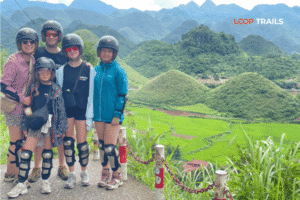
Mu Cang Chai and Ha Giang: The Rice Terrace Trip
Facebook X Reddit Table of Contents Two of the best landscapes in northern Vietnam sit about a province apart, and most people

Thúy Kiều (Grace) is a travel blogger and content contributor for Loop Trails Tours Ha Giang. She holds a bachelor’s degree in Sustainable Tourism from Vietnam National University, Hanoi, and has a strong passion for exploring and promoting responsible travel experiences in Vietnam’s northern highlands.
Learn more: Ha Giang Loop Tours
Every traveller who decides to visit Ban Gioc waterfall runs into the same wall at roughly the same moment. You look at a map, you see Cao Bang sitting up in the far northeast against the Chinese border, and you realise there is no flight, no train, and no obvious way to get there except a long stretch of road through the mountains. Then you open a booking site and find yourself staring at three words you do not fully understand: bus, limousine, private car.
I have made the Hanoi to Cao Bang run more times than I can count, in every vehicle available, in the middle of summer downpours and on cold clear January mornings. This guide is what I wish someone had handed me the first time. It covers what each option actually feels like from the inside, who each one suits, what to check before you pay, and how to avoid the two or three small errors that turn a manageable journey into a miserable one.
One thing before we start: prices, departure times and schedules on this route shift with the season, with fuel, and with whichever operators are running that month. I am not going to invent numbers for you. Where a figure matters, I will tell you exactly where to check the current one.
Learn more: Ha Giang Loop 2 Days 1 Night
If you are short on patience, here it is.
Learn more: Ha Giang Loop 3 Days 2 Nights
Cao Bang city sits roughly 280 km north of Hanoi, deep in the karst country of the northeast. Most road routes climb up through Thai Nguyen and Bac Kan on QL3, the old national highway, before the final approach into the Cao Bang valley. There are expressway sections on the lower part of the route, and a major new expressway project connecting the region has been under construction, which over time will change travel times on this corridor. Check the latest updates before you plan a tight connection, because what was true last year may not be true when you travel.
That 280 km number tricks people. On a European or American map, 280 km is a lazy three hours. Here it is not. Once the road leaves the flat land, it starts climbing, bending, dropping and climbing again. Trucks crawl. Overtaking is patient work. In practice, most travellers report the journey taking somewhere in the range of six to eight hours depending on vehicle, traffic, weather and how many stops the driver makes. Treat it as most of a day, not a morning errand.
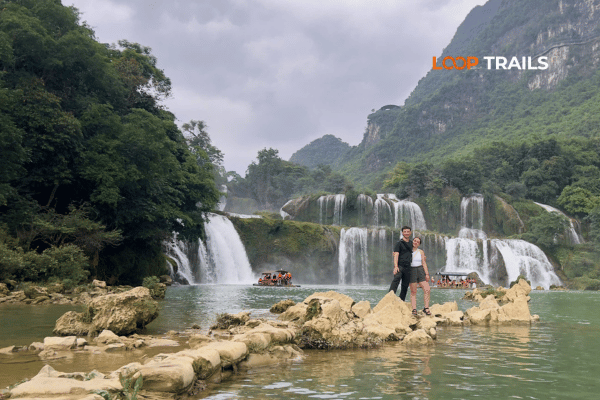
Cao Bang province itself is not a single destination. It is a wide, mountainous region that holds Ban Gioc waterfall on the Chinese border, the Nguom Ngao cave system, Thang Hen lake, the Phia Oac and Phia Den highlands, Pac Bo, the Ma Phuc pass, and the whole of the Non Nuoc Cao Bang UNESCO Global Geopark. Cao Bang city is your gateway and your logistics base. It is not the destination itself, and that distinction matters enormously when you plan.
Planning the whole northern loop, not just one leg? Most of our guests reach Cao Bang as part of a longer route through the mountains rather than as a separate trip from Hanoi. Have a look at our Ha Giang and Cao Bang combined tours if you would rather ride into Cao Bang over the mountain roads than sit on a bus from the capital.
Learn more: Ha Giang Loop 4 Days 3 Nights
Cao Bang has no passenger railway line and no commercial airport. Every arrival is a road arrival. That single fact shapes everything else.
It means your journey has a fixed floor of roughly six to eight hours from Hanoi, and no amount of money buys you a shortcut. A private car with a good driver will be more comfortable than a bus, but it will not be dramatically faster, because the road is the road and the mountains do not care about your budget.
It also means the first and last day of any Cao Bang trip get eaten by transport. A “three days in Cao Bang” plan that starts in Hanoi on the morning of day one and ends back in Hanoi on the evening of day three is really about one and a half usable days on the ground. I have watched a lot of travellers discover this in the wrong order. Build your itinerary around the road, not in spite of it.
And it means the return leg deserves the same thought as the outbound one. Coming back from Cao Bang on the last evening before an international flight out of Hanoi is a genuinely risky plan. Give yourself a buffer night in Hanoi. Mountain roads, weather and landslides do not consult your airline.
Learn more: Ha Giang Cao Bang 5 Days 4 Nights
This is the backbone of long distance travel in Vietnam and the cheapest way to reach Cao Bang.
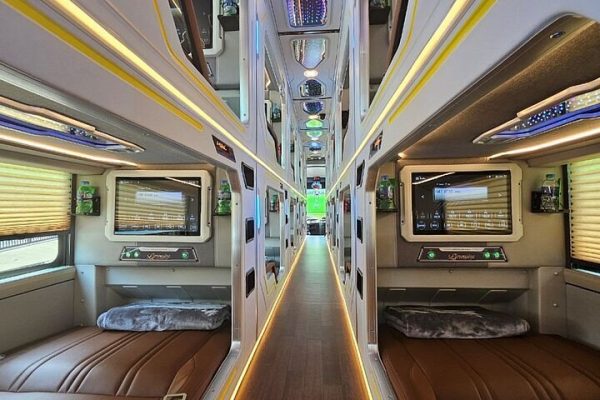
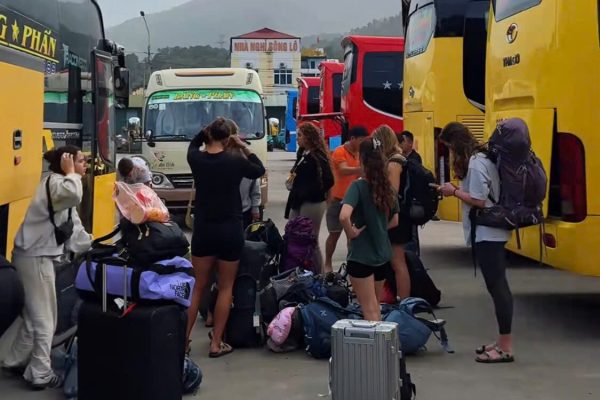
A sleeper bus is not a bus with reclining seats. It is a bus filled with bunk beds arranged in three rows and two levels. You take your shoes off at the door, put them in a plastic bag, and climb into a padded pod with a blanket. Your knees end up slightly raised. There is a divider between you and the person next to you, and there is not much else.
Buses to Cao Bang typically leave from Hanoi’s main northern bus stations, with My Dinh being the most common departure point and some services running from Gia Lam. Confirm which station your ticket is from before you leave your hotel. This is the single most frequent and most expensive mistake foreign travellers make on this route, and it costs people their bus.
There are day services and overnight services. Overnight sleepers arrive in Cao Bang early, sometimes uncomfortably early, and you will need somewhere to go at that hour.
Honest version: fine if you are relaxed, rough if you are not. The pods are built for Vietnamese frames, and if you are over about 180 cm tall you will feel it. Air conditioning is usually strong. Music sometimes plays. The driver will stop at a roadside restaurant along the way, and you will get twenty minutes or so to eat and use the toilet. Toilets on board, if present, are for emergencies rather than pleasure.
On the mountain sections you will feel every bend. Sleeping through the QL3 climb is possible but not guaranteed.
Solo travellers, backpackers, anyone who values the money more than the comfort, and people who genuinely can sleep anywhere. If you have already survived a Vietnamese sleeper bus elsewhere in the country, you know what you are getting.
Learn more: Ha Giang Cao Bang Ba Be Lake 6 Days 5 Nights
For most independent travellers, this is the one to book.
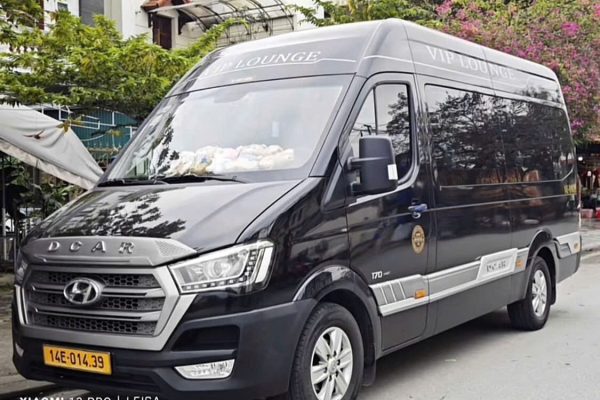
Forget the word you know. A Vietnamese limousine is a converted minivan, usually built on a Ford Transit or similar chassis, refitted with somewhere between nine and sixteen wide reclining seats instead of the standard rows. Some have individual cabin dividers. Some have a curtain. Most have USB charging, decent air conditioning, and bottled water.
The key difference is not luxury. It is that you get a proper seat, more legroom, fewer passengers around you, and a vehicle that handles the mountain road better than a heavy bus does.
You sit upright, you can read, you can look out of the window, and you arrive without the mild disorientation that a sleeper bus produces. The van is smaller, so it moves through traffic more nimbly. Drivers on the limousine routes tend to be a little more attentive to passenger comfort, because the whole product is sold on comfort.
Many limousine operators offer a pickup from your hotel if you are staying within a defined zone in central Hanoi, typically the Old Quarter and immediately around it. Others require you to come to a fixed meeting point. Do not assume. Ask when you book, and get the answer in writing.
Couples, solo travellers who want to arrive functional, anyone over about 175 cm, anyone travelling with a laptop or camera gear they do not want stacked in a bus hold, and anyone who gets carsick and needs to sit facing forward with a window in view.
Learn more: Cao Bang Loop 3 Days best kept secret
The option people dismiss on price and then wish they had taken.
A car and a driver, for you and your group only, leaving from your hotel door at the hour you choose. Typically a four seat sedan, a seven seat SUV or a sixteen seat van depending on group size and luggage. You stop where you like. If someone is feeling sick, you pull over. If the light over the Bac Kan valley is beautiful, you take a photo.
For a group of three or four, the cost per person moves surprisingly close to what each of you would pay for a limousine seat. Run the maths before you rule it out. Ask any operator for a per vehicle quote and divide it yourself.
Quiet, flexible, and low stress. You keep your luggage in the boot rather than in a communal hold. You control the temperature. You can ask for a proper lunch stop rather than a rushed one. If you are travelling with children, with older parents, or with anyone who needs to stop more often than a bus timetable allows, this stops being a preference and becomes the only sane choice.
The honest downside: it costs more, and on a solo budget it rarely makes sense.
Families. Small groups. Travellers with mobility issues. Anyone with an early flight the following day who cannot afford a delay they do not control. Photographers who want the road, not just the destination.
Learn more: Ngoc Con Valley& Pi Pha Viewpoint
Here is the part of this guide that will actually change some people’s trips.
A very large share of travellers heading to Cao Bang have already been, or are about to go, to Ha Giang. And Ha Giang and Cao Bang are neighbours. The overland route between them runs through Meo Vac, over the mountains, down through Bao Lac, and onward into Cao Bang province. It is one of the most spectacular stretches of road in Vietnam and almost nobody on the standard tourist circuit sees it, because they go back to Hanoi in between.
Think about what the standard plan actually costs you. Hanoi to Ha Giang. Ha Giang Loop. Ha Giang back to Hanoi. A night in Hanoi. Hanoi to Cao Bang. Cao Bang. Cao Bang back to Hanoi. That is four long road legs and two nights burned on transport, just to visit two provinces that share a border.
The combined route removes the pointless middle. You ride the Ha Giang Loop, continue east instead of turning back, and arrive in Cao Bang over the passes with the Nho Que river and Ma Pi Leng behind you. You see Bao Lac, the Me Pia pass with its stacked switchbacks, and a landscape that changes character as you move from Ha Giang’s limestone plateau into Cao Bang’s greener karst.
You still have to get back to Hanoi at the end, and that leg is usually done by night bus from Cao Bang. But you have cut out two long transfers and gained an entire mountain range.
This is exactly why our Ha Giang and Cao Bang combined tours exist. If Ban Gioc is on your list and Ha Giang is on your list, do not treat them as two separate trips out of Hanoi. Message us on WhatsApp with your dates and we will tell you honestly whether combining them fits your schedule or not.

Learn more: Hanoi Sleeper Bus
Learn more: Ha Giang Loop by Wrangler Rubicon Jeep
| Sleeper bus | Limousine van | Private car | |
|---|---|---|---|
| Relative cost | Lowest | Middle | Highest per vehicle, competitive per person in a group |
| Comfort | Basic, lying flat in a pod | Good, real reclining seat | Best |
| Typical journey time | Longest, more stops | Comparable, sometimes quicker | Usually the quickest realistic option |
| Hotel pickup | Rarely | Often, within a central zone | Always |
| Departure flexibility | Fixed schedule | Fixed schedule | You choose |
| Luggage | Communal hold | Limited, check the rules | Boot space, no fuss |
| Stops on request | No | No | Yes |
| Best for | Solo budget travel | Couples and most independent travellers | Families, groups of three or four, anyone on a tight return schedule |
Journey times on all three depend on weather, roadworks and traffic. Nobody can promise you an arrival time on a mountain road, and you should be suspicious of anyone who does.
Learn more: Ha Giang Loop by Wrangler Rubicon Jeep
Read these as sentences and pick the one that sounds like you.
“I am travelling alone and every dollar matters.” Take the sleeper bus. Book an overnight service if you want to save a hotel night, but arrange where you are going at arrival hour before you get on it.
“I want to arrive in a decent state and I do not want to overthink it.” Take the limousine van. This is the default recommendation for a reason. Confirm the pickup zone and you are done.
“There are three or four of us.” Get a private car quote and divide it. You may be surprised. The flexibility on a mountain road is worth real money, especially if anyone in the group is prone to travel sickness.
“We are travelling with kids or with older parents.” Private car. There is no serious second option here.
“I am doing the Ha Giang Loop too.” Do not go back to Hanoi in the middle. Look at the combined route. If the dates do not allow it, then at minimum consider travelling Ha Giang to Cao Bang directly rather than triangulating through the capital.
“I want to ride, not sit.” Then the real question is not which bus to take. It is where your motorbike comes from. See our motorbike rental in Ha Giang if you want to build your own route, or the Cao Bang Loop tours if you want the roads without the logistics.
Learn more: Explore just the Cao Bang Loop
You have three realistic channels.
Booking platforms. Sites like Vexere, Baolau and 12Go list operators, times and current fares, and they take international cards. This is the easiest route if you are booking from abroad and cannot read Vietnamese. Fares and departure times shown there are the ones to trust, because they update. Anything you read in a blog post, including this one, is a snapshot.
Your hotel or hostel in Hanoi. They will book it for you, usually with a small markup, and they will get the pickup details right because they do it every week. Convenient, mildly more expensive, low risk.
Directly with the operator. Cheapest, but their sites are often Vietnamese only and payment can be awkward from a foreign card.
Whichever you use, screenshot the confirmation, write down the pickup address in Vietnamese, and save the operator’s phone number. On travel morning your driver will call you, and the conversation will be short and in Vietnamese. A hotel receptionist can translate in ten seconds. Do not be standing on a street corner at 6am without that number.
Book earlier than you think you need to during Vietnamese public holidays, during Tet, and in the autumn buckwheat and rice season when domestic travel surges northward. On a normal week you can often book a day or two ahead. On a holiday weekend, you cannot.

Learn more: Things to do in Cao Bang
There is a real trade here and it is not just about money.
Night travel saves you a hotel night and a daylight day. You board in the evening, you wake up in Cao Bang. In theory. In practice you will sleep in fragments, you will be dumped somewhere at an unfriendly hour, and you will spend your first morning in Cao Bang slightly hollow.
Day travel costs you a day of your itinerary but gives you the road. And on this route the road is worth something. The stretch through Bac Kan and up into the Cao Bang valley is genuinely beautiful, and you cannot see any of it at three in the morning.
My honest recommendation for a first visit: travel by day, arrive in the late afternoon, sleep properly in Cao Bang city, and start early the next morning towards Ban Gioc with a full tank of energy. You will get more out of the province that way than you will by saving one hotel night.
If you do go overnight, book a hotel with a 24 hour reception and tell them your arrival hour in advance. Arriving at 4am with nowhere to put your bag is a bad start to a good trip.
Learn more: Ha Giang to Cao Bang
QL3 is a working national highway, not a scenic byway. Trucks use it. It passes through towns where the traffic is dense and the horns are enthusiastic. The surface is generally decent, but there are stretches under repair at any given time, and after heavy rain in the summer months landslides and washouts do occur in the mountain sections. This is normal and it is managed, but it is why nobody can promise you an arrival time.
Once you climb past Bac Kan, the character changes. The road narrows, the bends tighten, the karst hills close in, and you start to understand why the province looks the way it does. The final approach into Cao Bang is one of those stretches where the landscape stops being background and becomes the point.
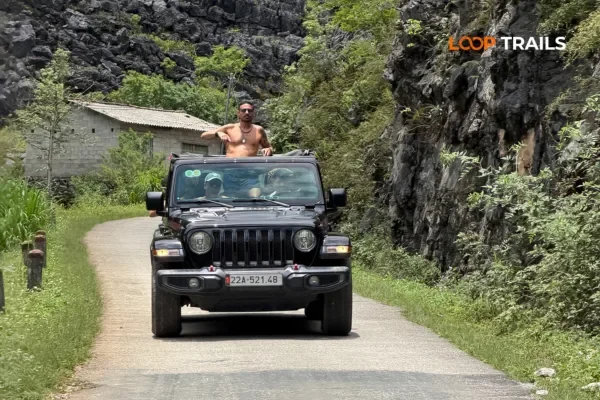
If you are driving yourself, and some travellers do ride motorbikes up from Hanoi, understand what you are taking on. It is a long, heavy day on a busy highway with a lot of truck traffic before you reach anything scenic. Most experienced riders skip this leg entirely, transport themselves and the bike, and start riding where the good roads start. There is no glory in QL3 south of Bac Kan.
Learn more: Nguom Ngao Cave
This deserves its own section because it catches more people than anything else on this route.
The mountain sections are continuous bends. Not dramatic switchbacks like Ma Pi Leng, just an endless, rhythmic left right left that goes on for hours. Passengers who are completely fine on flat roads discover something new about themselves somewhere north of Thai Nguyen.
What actually helps:
Sleeper buses are the worst option for anyone prone to this, because you are lying down, low, and near the back. If you know you get carsick, pay the difference for the van.

Learn more: Ha Giang Packing list
Not for Cao Bang. For the vehicle itself.
Keep a small day bag with all of this at your seat. Everything else goes in the hold, and you will not see it again until you arrive.
Learn more: Ha Giang Loop Mistake to Avoid
Cao Bang is not a scam heavy destination. It is a working province where tourism is a side dish, not the main course, and most of what goes wrong is confusion rather than malice. Still, a few patterns repeat.
The wrong bus station. Hanoi has several. Your ticket says one of them. Taxi drivers will happily take you to a different one. Check the name on your ticket, show it to the driver, and confirm before the car moves.
The taxi from Cao Bang bus station. You arrive tired, possibly in the dark, and the first fare quoted is not the local fare. Use a ride hailing app if there is coverage, ask your hotel to arrange a pickup, or agree the price before you get in.
The “included” tour that is not. Some transport packages advertise Ban Gioc as part of the deal in a way that turns out to mean “we will drop you at a place where you can buy a ticket.” Read what is actually included. Ask specifically about entrance fees.
Assuming Ban Gioc is next door. It is not. See the next section. This misunderstanding wrecks more Cao Bang itineraries than anything else.
Booking the return leg too tight. Do not schedule a night bus out of Cao Bang that connects to a morning international flight. Give yourself the buffer.
If a price feels wrong, ask a second person. If a route feels wrong, check a map. The province is friendly, and the locals will generally sort you out if you ask.
Learn more: Ban Gioc Waterfall Guide
This is the section most guides bury, and it is the one that changes plans.
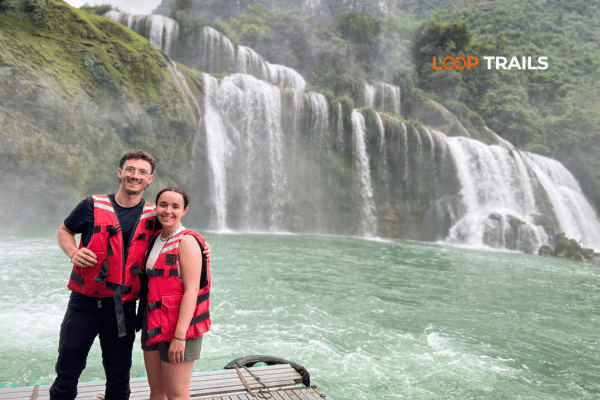
Ban Gioc waterfall is not in Cao Bang city. It sits roughly 90 km away to the northeast, near Trung Khanh, right on the Chinese border. The road climbs over the Ma Phuc pass and winds through some genuinely lovely karst country, and it takes most vehicles somewhere in the region of two and a half to three hours each way. Call it a full day trip out and back, with time at the waterfall and a stop at the Nguom Ngao cave, which is close by and worth the detour.
So when someone says “I have one day in Cao Bang,” what they usually have is one day of driving with a couple of hours at a waterfall in the middle. That is a legitimate plan, but it is not a relaxed one.
Your options from Cao Bang city:
If you want to see more than Ban Gioc, and Cao Bang gives you plenty of reasons to, budget two or three days in the province. Thang Hen lake, Phia Oac, Pac Bo and the geopark routes all deserve their own time. A two day Cao Bang visit is comfortable. A one day visit is a photograph.
Learn more: Ha Giang Motorbike Rental
Plan A: Cao Bang on its own, four days from Hanoi
Day 1: Hanoi to Cao Bang by limousine van, leaving in the morning. Arrive late afternoon. Eat well, sleep early. Day 2: Ban Gioc and Nguom Ngao cave, full day out and back. Day 3: Thang Hen lake, the Ma Phuc pass area, or Phia Oac, depending on weather. A slower day. Day 4: Return to Hanoi. Travel by day if you can, by night bus if your schedule demands it. Do not fly out the same evening.
Plan B: Ha Giang and Cao Bang together
Start in Ha Giang. Ride the Loop. Instead of turning back towards Hanoi, continue east through Meo Vac and Bao Lac into Cao Bang province, arriving over the mountains rather than up the highway. Spend your last days on Ban Gioc and the geopark, then take the night bus back to Hanoi from Cao Bang city at the end.
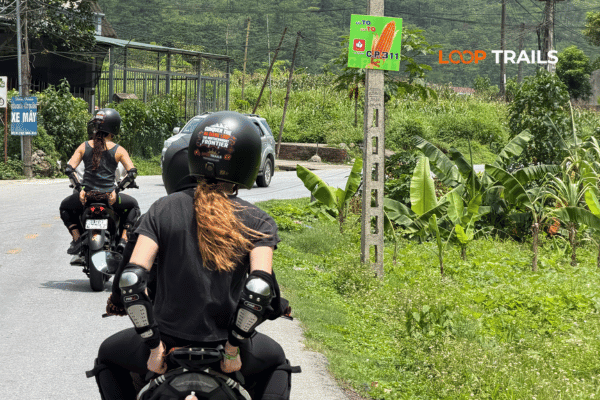
Plan B costs you almost the same number of days as doing both provinces separately, and gives you a completely different trip. It is what we build most of our combined itineraries around, and it is the plan I recommend to anyone with the time to do it properly.
Learn more: Ha Giang Loop Easy Rider
If Cao Bang is on your list, the transport question is only the first of about ten. What most travellers actually want is for someone to handle the road, the homestays, the permits and the routing so they can look out of the window instead of at a booking site.
That is what we do. Have a look at:
Or just message us on WhatsApp with your dates and how many days you have. We will tell you honestly what fits and what does not, even if the honest answer is that you should skip one of them this trip.
Most travellers report somewhere in the range of six to eight hours by road, depending on the vehicle, traffic and weather. There is no faster alternative, since there is no train and no airport. Build a full travel day into your plan rather than a half day.
No. Cao Bang has no passenger railway line. Every arrival is by road, whether that is a bus, a limousine van, a private car or your own motorbike.
No. There is no commercial airport in Cao Bang province at the time of writing. Road transport from Hanoi is the standard route for all visitors.
For most travellers, the limousine van. You get a real reclining seat, fewer passengers, better air conditioning, and usually a pickup near your hotel. The sleeper bus is cheaper and perfectly usable if your budget is tight and you can sleep in a pod.
Services typically run from Hanoi’s northern bus stations, with My Dinh the most common departure point and some operators using Gia Lam. Always confirm the station printed on your ticket before you leave your hotel, because they are not close together.
Fares change with the operator, the season and the vehicle type, so check current prices on a booking platform such as Vexere, Baolau or 12Go rather than trusting any figure written in a blog. As a rule, the sleeper bus is cheapest, the limousine sits in the middle, and a private car is the most expensive per vehicle but competitive per person for a group of three or four.
No, and this catches people out. Ban Gioc is roughly 90 km from the city, near Trung Khanh, and the mountain road takes most vehicles two and a half to three hours each way. Plan a full day for the trip, ideally including the nearby Nguom Ngao cave.
Night travel saves a hotel night but leaves you tired and dropped somewhere at an awkward hour. Day travel costs you a day but gives you a genuinely scenic road through Bac Kan and into the Cao Bang valley. For a first visit, travel by day.
On an ordinary week you can usually book a day or two ahead. During Tet, national holidays and the busy autumn travel season, book as early as you can, because domestic demand on this route rises sharply.
Yes, and it is often the better plan. The overland route from Ha Giang runs through Meo Vac and Bao Lac into Cao Bang province, which removes two long transfers through Hanoi and adds some of the finest mountain riding in Vietnam.
QL3 is a busy working highway with heavy truck traffic, and the mountain sections have continuous bends. Landslides can occur after heavy summer rain. Conditions change, so check local updates before you travel, and give yourself buffer time before any onward flight.
Sit as far forward as you can, take medication before you board rather than after, keep your eyes on the horizon instead of your phone, and avoid the sleeper bus if you can afford the van. The bends between Thai Nguyen and Cao Bang are relentless.
Contact information for Loop Trails
Website: Loop Trails Official Website
Email: looptrailshostel@gmail.com
Hotline & WhatSapp:
+84862379288
+84938988593
Social Media:
Facebook: Loop Trails Tours Ha Giang
Instagram: Loop Trails Tours Ha Giang
TikTok: Loop Trails
Office Address: 54A Tran Phu, Ha Giang 2, Tuyen Quang
Address: 54A Tran Phu, Ha Giang 2, Tuyen Quang
Facebook X Reddit Table of Contents Two of the best landscapes in northern Vietnam sit about a province apart, and most people

Facebook X Reddit Table of Contents Short answer: mostly no, and it depends entirely on what you mean by two days. That
Facebook X Reddit Table of Contents Twelve days is the length at which northern Vietnam stops being a highlights tour and starts